

Summary
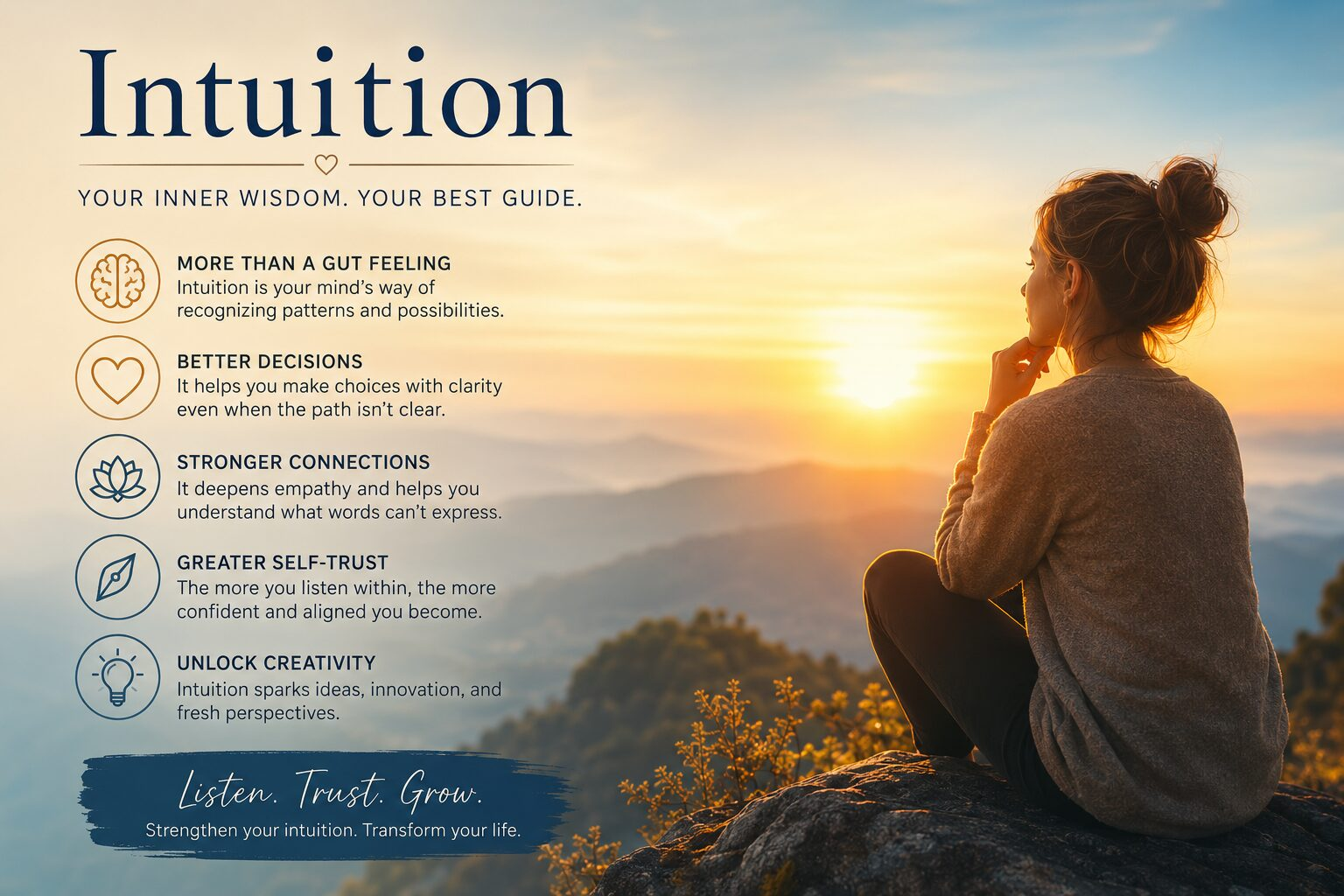
Discover what intuition really is, how it works, and why strengthening your inner guidance can lead to better decisions, stronger relationships, and greater confidence.
Intuition isn’t a Stranger.
We often hear phrases like “Trust your gut,” “I had a feeling,” or “Something just didn’t seem right.” While intuition has sometimes been dismissed as vague or mystical, modern psychology and neuroscience suggest that intuition is actually an important cognitive ability. It is the brain’s remarkable capacity to recognize patterns, process enormous amounts of information beneath conscious awareness, and produce rapid judgments that can often guide us wisely.
Intuition is not magic. It is not wishful thinking, fear, or impulse. Rather, it is the culmination of your experiences, observations, emotions, and subconscious learning working together to provide insights that your conscious mind may not yet be able to explain.
Like any valuable skill, intuition becomes stronger the more it is developed. Strengthening your intuition can improve decision-making, relationships, creativity, confidence, and overall well-being. Learning to recognize and trust this inner guidance can become one of the most valuable investments you ever make.
What Is Intuition?
Intuition is the ability to understand or know something immediately without consciously reasoning through every step.
Imagine walking into a room and sensing tension before anyone speaks. Or meeting someone for the first time and feeling unexpectedly comfortable—or uneasy. Perhaps you’ve solved a difficult problem after stepping away from it, only to have the answer “appear.”
These experiences are examples of intuition at work.
Your brain constantly gathers information through your senses. It notices facial expressions, tone of voice, body language, environmental cues, past experiences, and subtle details that your conscious mind may overlook. While you are focused on one thing, your subconscious is quietly analyzing thousands of pieces of information.
When enough evidence accumulates beneath awareness, intuition delivers the conclusion as a feeling, an impression, or a sudden knowing.
The Science Behind Intuition
Researchers have found that intuition often arises from unconscious pattern recognition.
Every experience you have builds an internal library of memories and patterns. Over time, your brain becomes remarkably efficient at comparing current situations with past experiences.
Experts frequently rely on intuition because they have spent years developing these mental libraries.
For example:
- Experienced firefighters sometimes leave a burning building moments before it collapses—not because they consciously noticed every warning sign, but because their brains recognized subtle patterns.
- Skilled physicians may suspect a diagnosis before laboratory results confirm it.
- Professional athletes often react faster than conscious thought would allow because their brains instantly recognize familiar situations.
This doesn’t mean intuition is always correct, but it demonstrates that intuition is often based on real information processed beneath conscious awareness.
Here are a few articles to check out regarding the studies done on intuition:
Intuition – It’s More Than a Feeling
Intuition vs. Emotion
One of the greatest challenges is distinguishing intuition from emotion.
They can feel similar, but they originate differently.
Intuition often feels like:
- Calm certainty
- Quiet knowing
- Gentle guidance
- Persistent insight
- Clear direction without panic
Fear often feels like:
- Urgency
- Catastrophic thinking
- Anxiety
- Racing thoughts
- Desire to escape immediately
Wishful thinking often feels like:
- Hoping something is true
- Ignoring warning signs
- Seeking only confirming evidence
- Emotional excitement overriding logic
Developing intuition includes learning to recognize these differences.
Why Strengthening Intuition Matters
Better Decision-Making
Every day, we make hundreds of decisions.
Some are simple.
Others involve careers, finances, health, relationships, or major life changes.
Facts and logic remain essential, but they don’t always provide complete answers. Intuition helps us evaluate situations where information is incomplete or uncertain.
The strongest decisions often combine thoughtful analysis with intuitive insight.
Stronger Relationships
Intuition helps us understand people beyond their words.
We notice:
- Changes in mood
- Hidden discomfort
- Genuine sincerity
- Manipulation
- Emotional needs
Developing intuition can improve communication, empathy, and emotional intelligence while helping us recognize healthy and unhealthy relationship dynamics.
Increased Self-Trust
Many people constantly second-guess themselves.
Strengthening intuition builds confidence because you begin recognizing that your internal guidance has value.
Instead of relying solely on outside opinions, you learn to consider your own wisdom.
This doesn’t eliminate mistakes—but it reduces chronic self-doubt.
Greater Creativity
Many artists, inventors, musicians, entrepreneurs, and writers describe creative breakthroughs arriving suddenly.
Often, these ideas emerge after periods of rest rather than intense effort.
Intuition helps connect ideas in unexpected ways, allowing innovative thinking to flourish.
Enhanced Safety
Our brains evolved to detect danger.
Sometimes intuition alerts us before conscious reasoning catches up.
Many people recall situations where they felt compelled to leave a location, avoid a person, or change plans—only later realizing there were genuine warning signs they hadn’t consciously recognized.
While intuition should not replace evidence, it can serve as an important early warning system.
We offer an Intro to Psychic Development that does foster trust in your intuition each month. Check the calendar for the next one.
Common Myths About Intuition
Myth 1: Intuition Is Psychic
Intuition is not necessarily supernatural.
Most intuitive experiences can be explained through subconscious information processing, emotional awareness, and pattern recognition.
Myth 2: Intuition Is Always Right
No human ability is perfect.
Biases, trauma, stress, and emotions can distort intuitive feelings.
Healthy intuition develops alongside critical thinking—not instead of it.
Myth 3: Only Certain People Have Intuition
Everyone possesses intuition.
Some people simply cultivate it more intentionally.
Like learning a language or strengthening a muscle, intuition improves through consistent practice.
How to Strengthen Your Intuition
1. Slow Down
Constant busyness drowns out subtle inner signals.
Spend a few quiet minutes each day without distractions.
Silence gives intuition room to surface.
2. Practice Mindfulness
Mindfulness improves awareness of thoughts, emotions, and bodily sensations.
The more present you become, the easier it is to recognize intuitive impressions instead of reacting automatically.
3. Reflect on Past Experiences
Think about moments when your intuition proved accurate.
Ask yourself:
- What did it feel like?
- What clues did I notice?
- How was it different from anxiety?
Patterns begin to emerge.
4. Keep an Intuition Journal
Write down:
- Gut feelings
- Dreams
- Sudden ideas
- Decisions
- Outcomes
Over time, you’ll discover whether your intuitive impressions tend to be reliable and under what circumstances.
5. Reduce Mental Noise
Constant notifications, social media, and multitasking make it difficult to hear your own thoughts.
Regular periods of digital quiet help strengthen self-awareness.
6. Listen to Your Body
Intuition is often experienced physically.
You may notice:
- Relaxation
- Tightness
- Warmth
- Calm breathing
- A sinking feeling
- Increased alertness
Learning your body’s signals can provide valuable information.
7. Balance Intuition With Logic
Healthy decision-making asks two questions:
- What do the facts suggest?
- What does my intuition say?
When both point in the same direction, confidence often increases.
When they conflict, it’s worth slowing down and investigating further.
What Blocks Intuition?
Several factors interfere with intuitive awareness:
- Chronic stress
- Sleep deprivation
- Information overload
- Fear of making mistakes
- Low self-confidence
- Constant external validation
- Ignoring past experiences
- Emotional overwhelm
Reducing these obstacles often allows intuition to become clearer.
The Role of Experience
Intuition grows stronger through experience.
A beginner chess player analyzes every move.
A grandmaster often recognizes the best move almost instantly.
The difference isn’t magic.
It’s years of accumulated learning transformed into intuitive recognition.
Whatever your field—parenting, teaching, business, healthcare, engineering, or art—the more experience you gain, the more refined your intuition can become.
Practical Ways to Use Intuition Every Day
You don’t need dramatic life decisions to practice intuition.
Try using it when:
- Choosing between opportunities
- Meeting new people
- Solving creative problems
- Planning your schedule
- Deciding when to rest
- Selecting priorities
- Evaluating long-term goals
Pause briefly before deciding.
Notice your immediate impression.
Then compare it with logical analysis.
Over time, this practice strengthens both intuition and judgment.
When Not to Rely on Intuition Alone
Although intuition is powerful, it should not replace evidence in situations involving significant consequences.
Seek objective information for decisions involving:
- Medical treatment
- Legal matters
- Financial investments
- Safety risks
- Scientific conclusions
The wisest approach combines intuition with research, expert advice, and critical thinking.
Final Thoughts
Intuition is one of the mind’s most fascinating abilities. Far from being mysterious guesswork, it is often the product of countless experiences, subtle observations, and unconscious pattern recognition working together behind the scenes.
Strengthening your intuition does not mean abandoning logic or embracing every fleeting feeling. Instead, it means becoming more aware of the quiet signals your mind and body provide, learning to distinguish genuine insight from fear or impulse, and integrating that awareness with thoughtful reasoning.
As you cultivate mindfulness, reflect on your experiences, and practice listening to your inner guidance, you build a deeper sense of self-trust. Decisions become more intentional, relationships more authentic, creativity more accessible, and your ability to navigate uncertainty more resilient.
Intuition is not a shortcut around wisdom—it is one of the ways wisdom speaks. When paired with knowledge, evidence, and self-awareness, it becomes a powerful ally in living a thoughtful, balanced, and fulfilling life.